Buying near East Bay open space can provide beautiful views and trail access, but the property deserves additional investigation before you make an offer.Homes near ridgelines, regional parks,,

Dated: July 31 2026
Views: 73
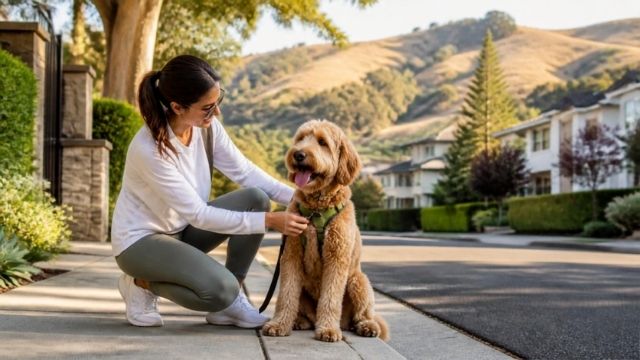
There is a simple summer habit I wish every dog owner would adopt before heading out for a walk:
Reach down and touch the ground.
Not glance at the weather app. Not assume the sidewalk is fine because the air feels tolerable. Actually put your hand on the surface your dog is about to walk across.
On a sunny day, pavement can be dramatically hotter than the air around it. The American Kennel Club cites data showing that when the air temperature is 86°F, asphalt can reach 135°F. At that temperature, the walk you’re enjoying in sneakers can be a very different experience for the dog walking beside you.
Here in the East Bay, that’s worth paying attention to. Danville, San Ramon, Walnut Creek and the surrounding communities routinely experience hot, sunny summer days. Our dogs still need exercise and they certainly aren’t going to stop asking for walks just because July showed up.
A little awareness can make those walks much safer.
This is the part that’s easy to forget.
Weather forecasts measure air temperature. Your dog’s paws are touching a surface that’s absorbing energy from the sun.
Dark asphalt is particularly effective at getting hot.
According to the AKC, asphalt has been measured at 135°F with an air temperature of just 86°F. The organization warns that pavement, asphalt and artificial grass can become hot enough to cause discomfort, blisters and burns to paw pads.
Concrete can become dangerously hot too. So can artificial turf, sand, metal and other surfaces exposed to direct sunlight.
UC Davis School of Veterinary Medicine specifically warns that sidewalks, asphalt, sand and artificial turf can become dangerously hot during summer.
That’s why there isn’t one perfect air-temperature chart that tells you whether every surface is safe.
Sun exposure matters. Surface material matters. Shade matters. Time of day matters.
Fortunately, there’s a much easier test.
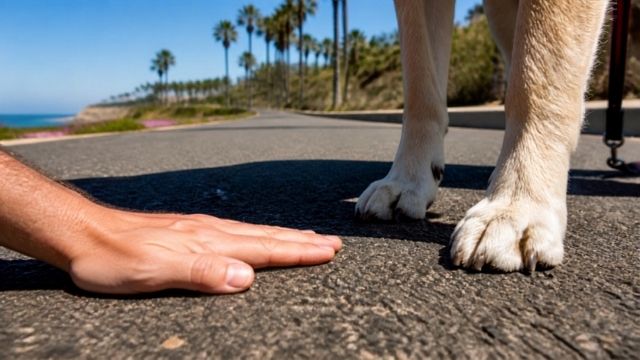
Before the walk, touch the pavement.
UC Davis recommends placing the back of your hand on the pavement for seven seconds. If you cannot comfortably leave it there, the surface is too hot for your dog to walk on.
The AKC offers essentially the same advice using a 10-second hand test.
Seven seconds. Ten seconds.
I’m less concerned about splitting hairs over three seconds than I am about people actually reaching down and checking.
If you immediately want to pull your hand away, there’s your answer.
Your dog shouldn’t be walking on it.
Dog paw pads are tough. That’s part of their job.
But tough doesn’t mean burn-proof.
The AKC specifically cautions against treating paw pads like shoes. Hot sidewalks and streets can burn them even though the pads are more durable than human feet.
And there’s another problem.
Dogs don’t always communicate discomfort the way we expect them to.
They’re excited. They’re walking with their person. They’re smelling everything that happened in the neighborhood since approximately 6:14 that morning.
They may keep moving even when the surface is uncomfortable.
We have shoes between us and the ground, so we don’t receive the same warning they do.
That’s why the hand test matters.
It’s easy to make asphalt the villain because black pavement obviously gets hot.
But don’t automatically assume the sidewalk is safe.
UC Davis includes sidewalks, asphalt, sand and artificial turf among summer surfaces capable of becoming dangerously hot.
Think about that last one for a moment.
Artificial turf is increasingly common in California backyards because it’s attractive, doesn’t need irrigation and doesn’t turn into a mud pit.
For dog owners, it can seem nearly perfect.
But artificial turf exposed to direct summer sun can become hot. If you’re evaluating a home with turf or considering installing it, shade and summertime usability deserve consideration too.
The same applies to patios, pool decks and hardscaping.
A beautiful backyard should also be one your dog can comfortably use.
The easiest solution usually doesn’t require buying anything.
Change the schedule.
UC Davis recommends exercising pets during cooler parts of the day. For hot surfaces specifically, its veterinarians suggest walking early in the morning or after sunset and choosing grassy or shaded paths.
For many East Bay dog owners, that means making the longer walk the morning activity.
During the hottest part of the day, bathroom breaks can be shorter and focused on grass or shade.
Then everybody gets another proper walk when temperatures and surfaces cool later.
One important point: don’t assume pavement is safe the moment the air starts cooling.
The surface has been absorbing heat for hours.
Touch it.
Your hand gives you information about the actual surface your dog will be walking on right now.
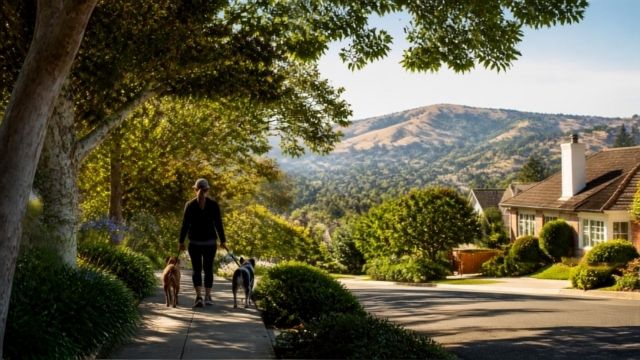
If you’re already out and discover the pavement is hotter than expected, change the route.
Look for:
Protective dog booties can also provide a barrier when hot surfaces are unavoidable, although dogs generally need time to become comfortable wearing them.
Personally, I wouldn’t use booties as an excuse for a long afternoon walk during extreme heat.
Hot pavement is only one part of the equation.
A dog’s paws may be touching a surface far hotter than the surrounding air while the rest of the dog’s body is also dealing with summer heat.
Dogs primarily regulate body temperature through panting and have only limited sweating through their paw pads.
UC Davis lists signs of overheating that include excessive panting, excessive drooling, lethargy, vomiting, abnormal gum color, difficulty breathing and collapse. Heatstroke is a medical emergency.
This is particularly important when deciding whether your dog needs that afternoon walk at all.
Sometimes the answer is no.
Fresh water, air conditioning and a dog sprawled dramatically across the coolest section of your kitchen floor can be a perfectly respectable afternoon plan.
Pay attention after walking on hot surfaces.
Burned or irritated paw pads can cause discomfort and may lead to licking or chewing at the feet. The AKC notes that hot sidewalks can cause irritation or blisters and recommends examining the paws, including between the toes and pads, when a dog begins licking them excessively.
If you see an apparent burn, blistering, significant redness or your dog is limping or clearly uncomfortable, contact your veterinarian for guidance.
Don’t wait for a serious injury to prove the pavement was too hot.
Prevention takes seconds.
One reason I’m writing about this isn’t because dog owners don’t care.
Quite the opposite.
Most of us would do practically anything for our dogs.
We simply experience the environment differently than they do.
We’re wearing shoes.
They’re walking barefoot.
We’re five or six feet above the pavement.
They’re inches from it.
And when you’re standing outside on an 86-degree afternoon thinking, “It’s warm, but it’s not that bad,” the asphalt beneath you could tell a very different story.
That’s the part worth sharing with a neighbor.
Before your next summer dog walk, do one thing.
Reach down.
Touch the pavement with the back of your hand and leave it there for several seconds.
If you can’t comfortably keep your hand on it, find some grass, find some shade or save the walk for later.
Our dogs trust us to make those decisions for them.
And considering how much they do for us, checking the pavement seems like a pretty good deal.

Real estate is personal. It’s not just about finding a house or selling a property. It’s about how people live, what matters most and where they want to go next. I’m Mike White, a Lifestyle Real....
Buying near East Bay open space can provide beautiful views and trail access, but the property deserves additional investigation before you make an offer.Homes near ridgelines, regional parks,,
Early fall can create a useful East Bay real estate window for buyers and sellers who understand how September changes the market.The first week of September does not suddenly transform East Bay
East Bay homeowners can reduce wildfire vulnerability by combining defensible space, home hardening, and planning ahead.Late summer is a practical time to look at the property as a system.,
East Bay sellers can protect their time and equity by repairing the correct problems before the home reaches the market.Preparing a home for sale does not mean fixing everything. The better goal is
 Last updated: September 22, 2026 11:27 PM UTC Property Information © 2026 MLSListings Inc. All rights reserved. Listing information is deemed reliable but not guaranteed. The data relating to real estate for sale on this display comes in part from the Internet Data Exchange program of the MLSListingsTM MLS system. Real estate listings held by brokerage firms other than REMAX Accord are marked with the Internet Data Exchange and detailed information about
them includes the names of the listing brokers and listing agents.
The information being provided by CARETS (CLAW, CRISNet MLS, DAMLS, CRMLS, i-Tech MLS, and/or VCRDS)
is for the visitor's personal, non-commercial use and may not be used for any purpose other than to identify
prospective properties visitor may be interested in purchasing.
Any information relating to a property referenced on this web site comes from the Internet Data Exchange (IDX)
program of CARETS. This web site may reference real estate listing(s) held by a brokerage firm other than the
broker and/or agent who owns this web site.
The accuracy of all information, regardless of source, including but not limited to square footages and lot sizes, is
deemed reliable but not guaranteed and should be personally verified through personal inspection by and/or with
the appropriate professionals. The data contained herein is copyrighted by CARETS, CLAW, CRISNet MLS,
DAMLS, CRMLS, i-Tech MLS and/or VCRDS and is protected by all applicable copyright laws. Any dissemination
of this information is in violation of copyright laws and is strictly prohibited.
CARETS, California Real Estate Technology Services, is a consolidated MLS property listing data feed comprised
of CLAW (Combined LA/Westside MLS), CRISNet MLS (Southland Regional AOR), DAMLS (Desert Area MLS),
CRMLS (California Regional MLS), i-Tech MLS (Glendale AOR/Pasadena Foothills AOR) and VCRDS (Ventura
County Regional Data Share)
Show More...
Last updated: September 22, 2026 11:27 PM UTC Property Information © 2026 MLSListings Inc. All rights reserved. Listing information is deemed reliable but not guaranteed. The data relating to real estate for sale on this display comes in part from the Internet Data Exchange program of the MLSListingsTM MLS system. Real estate listings held by brokerage firms other than REMAX Accord are marked with the Internet Data Exchange and detailed information about
them includes the names of the listing brokers and listing agents.
The information being provided by CARETS (CLAW, CRISNet MLS, DAMLS, CRMLS, i-Tech MLS, and/or VCRDS)
is for the visitor's personal, non-commercial use and may not be used for any purpose other than to identify
prospective properties visitor may be interested in purchasing.
Any information relating to a property referenced on this web site comes from the Internet Data Exchange (IDX)
program of CARETS. This web site may reference real estate listing(s) held by a brokerage firm other than the
broker and/or agent who owns this web site.
The accuracy of all information, regardless of source, including but not limited to square footages and lot sizes, is
deemed reliable but not guaranteed and should be personally verified through personal inspection by and/or with
the appropriate professionals. The data contained herein is copyrighted by CARETS, CLAW, CRISNet MLS,
DAMLS, CRMLS, i-Tech MLS and/or VCRDS and is protected by all applicable copyright laws. Any dissemination
of this information is in violation of copyright laws and is strictly prohibited.
CARETS, California Real Estate Technology Services, is a consolidated MLS property listing data feed comprised
of CLAW (Combined LA/Westside MLS), CRISNet MLS (Southland Regional AOR), DAMLS (Desert Area MLS),
CRMLS (California Regional MLS), i-Tech MLS (Glendale AOR/Pasadena Foothills AOR) and VCRDS (Ventura
County Regional Data Share)
Show More...
 All measurements and all calculations of area are approximate. Information provided by Seller/Other sources, not verified by Broker. All interested persons should independently verify accuracy of information. Provided properties may or may not be listed by the office/agent presenting the information. Data maintained by MetroList© may not reflect all real estate activity in the market.
All real estate content on this site is subject to the Federal Fair Housing Act of 1968, as amended, which makes it illegal to advertise any preference, limitation or discrimination because of race, color, religion, sex, handicap, family status or national origin or an intention to make any such preference, limitation or discrimination.
MetroList CA data last updated: September 22, 2026 11:07 PM UTC Terms of Use.
Vendor data provided by Inside Real Estate, LLC.
All measurements and all calculations of area are approximate. Information provided by Seller/Other sources, not verified by Broker. All interested persons should independently verify accuracy of information. Provided properties may or may not be listed by the office/agent presenting the information. Data maintained by MetroList© may not reflect all real estate activity in the market.
All real estate content on this site is subject to the Federal Fair Housing Act of 1968, as amended, which makes it illegal to advertise any preference, limitation or discrimination because of race, color, religion, sex, handicap, family status or national origin or an intention to make any such preference, limitation or discrimination.
MetroList CA data last updated: September 22, 2026 11:07 PM UTC Terms of Use.
Vendor data provided by Inside Real Estate, LLC.
 Bay East ©2026. CCAR ©2026. bridgeMLS ©2026. Information Deemed Reliable But Not Guaranteed. This information is being provided by the Bay East MLS, or CCAR MLS, or bridgeMLS. The listings presented here may or may not be listed by the Broker/Agent operating this website. This information is intended for the personal use of consumers and may not be used for any purpose other than to identify prospective properties consumers may be interested in purchasing. Data last updated at September
22, 2026 11:10 PM UTC
Show More...
Bay East ©2026. CCAR ©2026. bridgeMLS ©2026. Information Deemed Reliable But Not Guaranteed. This information is being provided by the Bay East MLS, or CCAR MLS, or bridgeMLS. The listings presented here may or may not be listed by the Broker/Agent operating this website. This information is intended for the personal use of consumers and may not be used for any purpose other than to identify prospective properties consumers may be interested in purchasing. Data last updated at September
22, 2026 11:10 PM UTC
Show More...
 This information, including square footage, while not guaranteed, has been acquired from sources believed to be reliable. Listings on this page identified as belonging to another listing firm are based upon data obtained from the SFAR MLS, which data is copyrighted by the San Francisco Association of REALTORS©, but is not warranted.
